Words as Weapons: How Media Framing Shapes the Iran War Narrative
Why “hit” and “destroyed” dominate coverage of US-Israeli strikes while “intercepted” and “no damage” define Iranian ones — and what that gap in language reveals.
contents
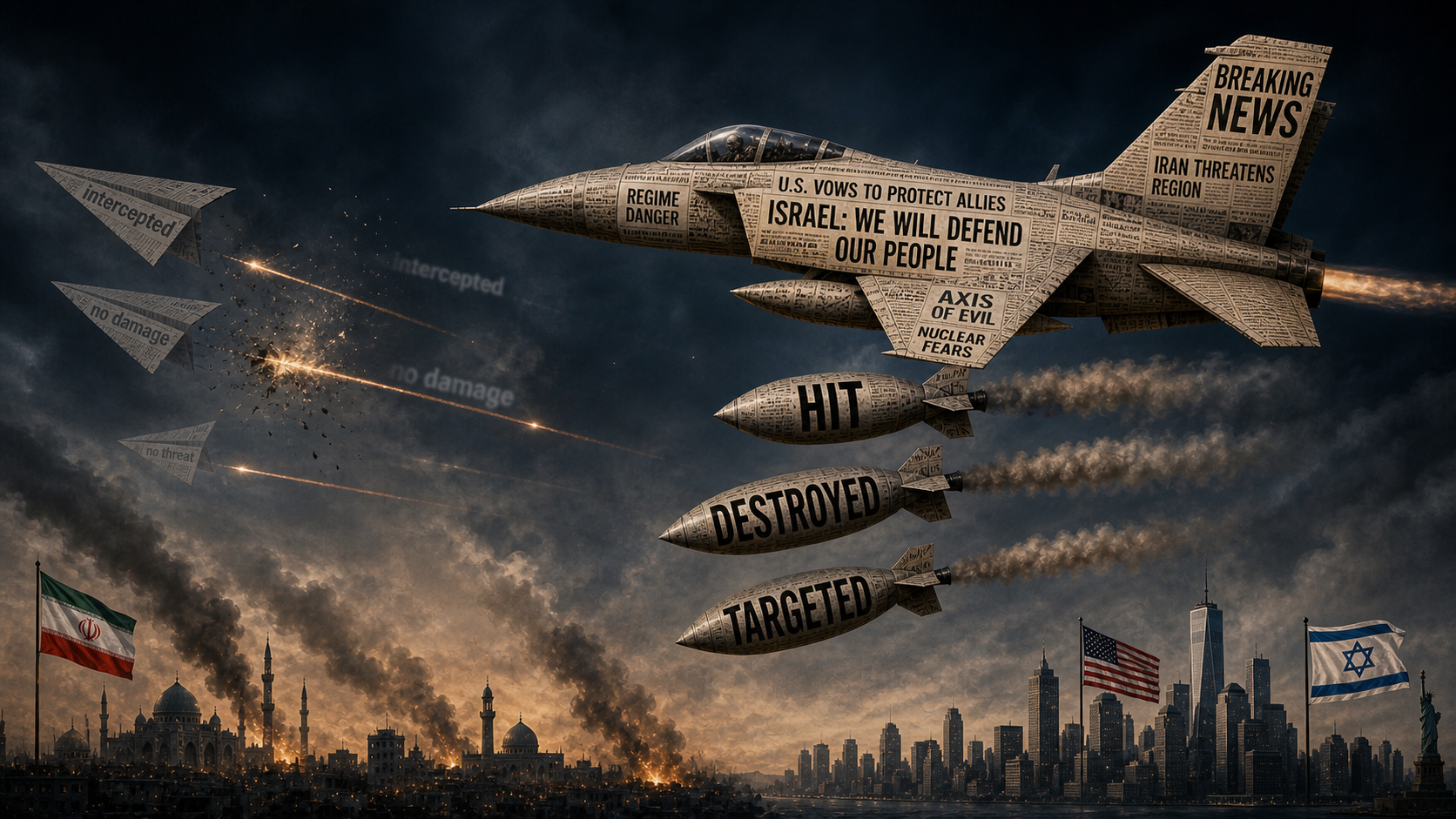
There is a pattern I cannot unsee: when Iran launches missiles, headlines often lead with “intercepted”, “targeted”, or “no damage”. When the US or Israel attacks Iran, the language is more often “hit”, “destroyed”, or “struck”. This difference is not proof that every Iranian claim is true or that every Western report is false. But it does shape what the public assumes before the evidence is fully available.
The Language Gap Is Documented
This is not only an impression. Analyses of coverage of the Iran–Israel–US confrontation argue that Western reporting frequently presents US and Israeli attacks through a “self-defence” frame while casting Iranian action as “provocation”, with consequences for how legitimacy, aggression, and civilian harm are understood1. A comparative study of American and European television coverage also found a broad predominance of “war journalism” — coverage that relies heavily on official sources and military frames rather than civilian impact and independent ground verification2.
Other comparative research identifies a related divide: Western coverage tends to foreground stability, deterrence, and security, while Middle Eastern coverage more often foregrounds sovereignty, historical grievance, and humanitarian consequences3. Neither lens is neutral. Each selects facts, sources, and language that make a different side’s violence appear more reasonable, necessary, or effective.
“Intercepted” Is Not a Final Assessment
An early statement that a missile was “intercepted” may be accurate in a narrow sense: an air-defence system engaged it. It does not, on its own, establish that every projectile was destroyed, that no debris reached a site, or that there was no damage. Nor does an initial “no damage” claim substitute for a completed battle-damage assessment.
The most reliable record often arrives later, through commercial satellite imagery, geolocation, post-strike photographs, repair activity, casualty reporting, and congressional disclosures. That delay gives official military narratives a major advantage: they become the first headline, while more complicated evidence appears days or weeks later.
The Evidence That Emerged Later
The Washington Post conducted a satellite-imagery investigation using imagery published by Iranian state-affiliated media and independently verified damage to at least 228 structures or pieces of equipment at US military sites. The Post found the extent of damage was substantially greater than what had previously been reported or publicly acknowledged by the US government4. Reporting on that investigation identified affected assets including hangars, barracks, fuel depots, aircraft, radar, communications, and air-defence equipment across multiple countries5.
The New York Times separately reported that satellite images released by Iran showed at least 20 structures at US-linked facilities completely or partly destroyed6. CNN also geolocated imagery showing a severely damaged US Air Force E-3 Sentry early-warning aircraft at Prince Sultan Air Base in Saudi Arabia after an Iranian strike7. Other CNN reporting based on satellite imagery described damage to the AN/TPY-2 radar component of the THAAD missile-defence system at the same base8.
These findings do not validate every official Iranian military claim. They do demonstrate that early accounts centered on “interception” and “no damage” did not tell the full story.
The Money Trail Matters
The question becomes even harder to dismiss when looking at the cost of the war. Pentagon comptroller Jules Hurst acknowledged during congressional questioning that the department’s public $29 billion war-cost figure did not include a final accounting of damage to US installations; when pressed, the Pentagon did not provide a complete figure9. Senator Patty Murray described the estimate as “suspiciously low” and criticized the lack of transparency over damage to US facilities9.
Senate Democrats later urged investigators to examine the Pentagon’s accounting. USA Today reported that outside analysts and congressional sources estimated repair and replacement costs — including battle damage not captured in the official figure — could add roughly $15–25 billion10. The discrepancy does not prove deliberate deception in every case, but it strongly suggests that initial public estimates were incomplete.
Why This Narrative Persists
There are practical reasons for the gap. Battle-damage assessment takes time, and militaries often withhold operational details for security reasons. But there are political reasons too: acknowledging effective Iranian strikes challenges claims of overwhelming air-defence superiority, raises the visible costs of the war, and weakens public confidence in escalation.
That creates a recurring informational sequence: an Iranian strike is immediately described as “intercepted” or ineffective; days later, satellite imagery, local evidence, or financial disclosures reveal a more serious outcome. By then, the first headline has already shaped the public impression.
Whose Media, Whose Narrative
Iranian state media is not neutral. It has obvious incentives to inflate Iran’s military effectiveness and suppress its own losses. But US and allied official statements should not be treated as neutral final verdicts either, especially when later independent imagery and reporting contradict the first account.
The deeper imbalance is one of reach and agenda-setting. American and allied outlets dominate the English-language information environment, with far greater resources, access to officials, and syndication power than Iranian domestic media. That influence helps establish which vocabulary becomes normal: US and Israeli attacks “hit”; Iranian attacks are “intercepted”, “targeted”, or said to have caused “no damage”.
The responsible response is not to reverse the bias and accept every Iranian claim uncritically. It is to treat all same-day military claims as provisional, distinguish official assertions from independently verified evidence, and revisit early headlines when the satellite record, repair data, and human consequences become visible. In war, the first account is often the most politically useful one — not necessarily the most complete.
References
-
Al Jazeera Media Institute — “Missiles Made of Words: How Western Media Narratives Shape the Iran–Israel–US Conflict” ↩
-
The Peerian Journal — “The Role of Framing in Reframing Conflict: A Comparative Quantitative Content Analysis of American and European Television Coverage of the 2025 Iran-Israel War” ↩
-
Qualitative Research Journal for Social Studies — “Bias and Ideology in Western and Middle Eastern Media Coverage of the Iran–Israel War” ↩
-
The Washington Post — “Iran has hit far more U.S. military assets than reported, satellite images show” ↩
-
Middle East Eye — “Satellite imagery suggests far more US assets in Middle East hit by Iran than reported” ↩
-
The New York Times — “What Visuals Show About Recent Damage to U.S. Military Bases” ↩
-
CNN — “Images show vital US radar aircraft damaged after Iranian strike” ↩
-
CNN reporting, summarized by Fakti — “Iran hits key US missile defense radar at Saudi air base” ↩
-
PBS NewsHour — “Murray calls Pentagon’s Iran war cost estimate ‘suspiciously low,’ presses for damage price tag” ↩ ↩2
-
USA Today — “Senate Dems urge investigators to check Pentagon’s math on Iran war” ↩
Comments
Select any passage above to comment on it directly. Markdown supported.
Loading comments…