When Fine Print Fails: How We Took On an Airline’s (Jetstar) "Final Position"
The story of how I got a full refund for a Jetstar flight cancelled due to weather.
contents
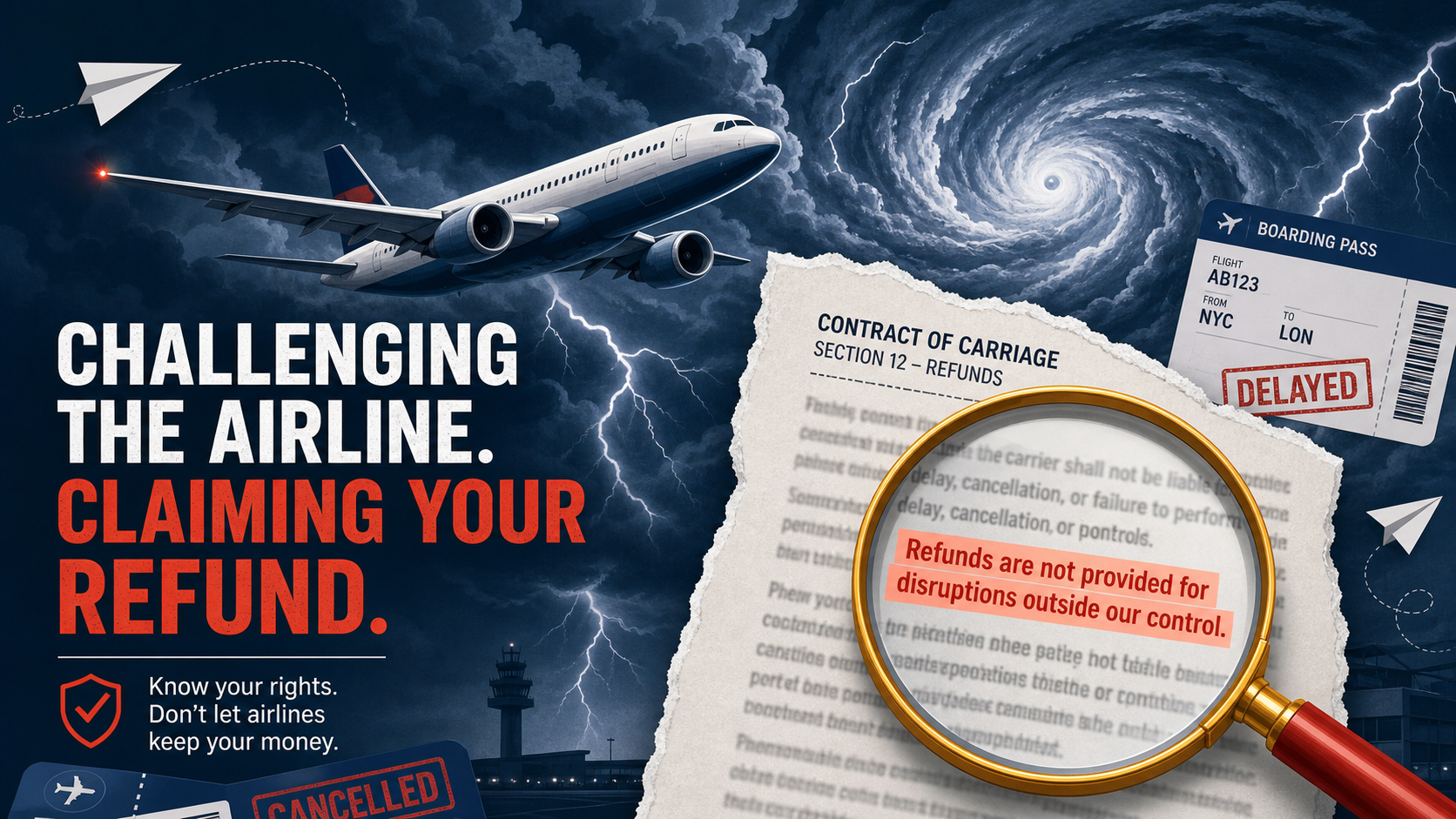
We were scheduled to fly from Melbourne to Brisbane on Jetstar Flight JQ568. A major cyclone (I think it was called Alfred) hit on March 6, the flight was suddenly pulled, and our travel plans were instantly wiped out. Basically, the beach of Brisbane was no more after the cyclone 🌀🤦🏻. Unheard of in the last 50 years 😐 (speaking of luck)
While weather cancellations are an unfortunate reality of travel, but in the EU at least we are used to just get a refund for our flight and call it a bad luck. So I was very surprised that it was not the case in Australia. What followed was a masterclass in corporate stonewalling—and an empowering reminder of why knowing your legal rights actually matters.
The Offer We Couldn’t Use
Shortly after the cancellation, Jetstar sent a notification and offered us their standard resolution: a credit voucher.
For local Australian frequent flyers, a voucher might be a fair compromise (depending on what you consider fair). But as residents of another continent, a domestic Australian flight credit is completely useless to us. I contacted their support team and requested what made sense: a full monetary refund for both of our bookings.
The initial support experience was incredibly frustrating. When I pressed for a refund, their live chat agent abruptly ended the session without notice, completely shutting down the conversation. Escalating the issue to Jetstar’s resolutions team only resulted in a firm “No.”
They cited Clause 8.2 of their Conditions of Carriage1:
8.2 Changes due to Events Beyond Our Control
Where we make a Significant Change to your flight due to an Event Beyond Our Control, whether you have checked in or not, we will:
- use reasonable endeavours to rebook you on the next available flight on our services at no additional cost to you; or
- alternatively, if we are unable to rebook you on services acceptable to you, we will provide you with a flight credit where the purpose of your trip cannot be achieved.
Claiming that because the disruption was caused by weather (an “Event Beyond Our Control”), their policy stated they were not obligated to issue cash refunds. To drive the point home, their agent quoted the clause in an email and declared that this was their “final position,” effectively stonewalling us and stating they would no longer respond to further inquiries.
Case closed? Not quite. It just sounded outrageous to me and I could not accept that.
Spotting the Omission in the Fine Print
Instead of taking “final position” for an answer, I decided to pull up Jetstar’s actual Conditions of Carriage to read Clause 8.2 line by line.
That’s when I noticed something glaring.
In their email denying our refund, the agent quoted the clause but conveniently stopped short right before the final sentence. The actual clause ends with a crucial caveat stating:
“You may also have rights to remedies under applicable law.”2
By deliberately leaving out that sentence, they were presenting their internal policy as absolute truth while hiding the very legal escape hatch built into it.
The Legal Grounding: Australian Consumer Law
Under the Australian Consumer Law (ACL)3, travel services automatically come with basic consumer rights known as consumer guarantees. One of these is the guarantee that services will be provided within a reasonable time.
When a business sells a product or service that fails to meet these consumer guarantees, it is legally required to offer the consumer a solution. A “major failure” occurs when a service is substantially unfit for purpose and cannot be fixed within a reasonable time, which entitles the consumer to choose between a replacement or a full refund.4
Crucially, an airline’s internal compensation policy does not replace the consumer guarantees that automatically apply. In short: internal terms and conditions cannot strip away statutory consumer protections.
Taking Action: The Final Resolution
With the law clearly on our side, I prepared a multi-pronged strategy:
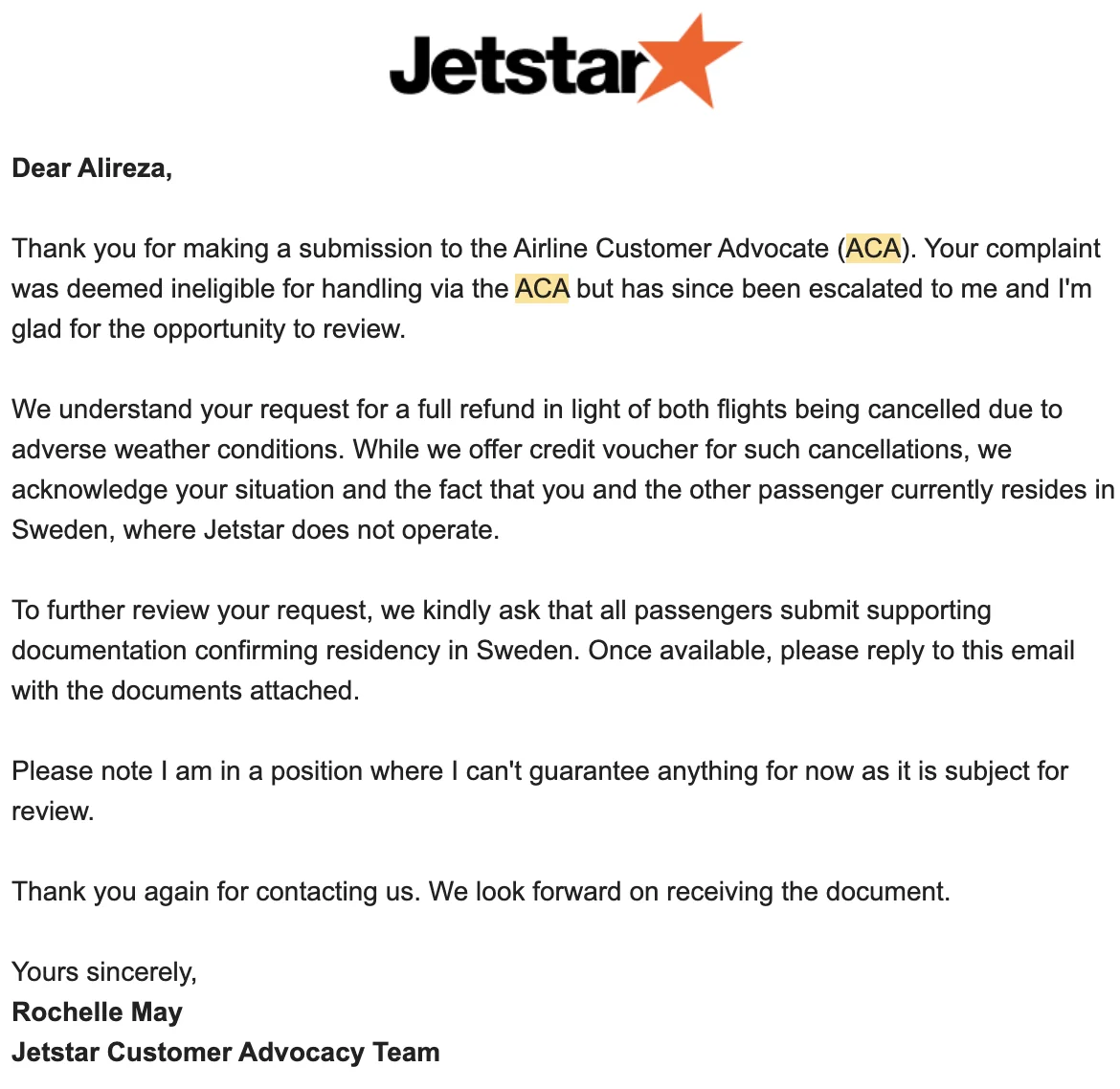
- The Formal Complaints: I didn’t just threaten to report them; I actually lodged formal complaints with the Airline Customer Advocate (ACA)5 and the Australian Competition and Consumer Commission (ACCC). Interestingly, while the ACA initially deemed the complaint ineligible, the sheer act of filing it triggered an internal escalation at Jetstar. My case was finally moved out of the standard “Resolutions” queue and handed over to their Customer Advocacy Team.
In case if you wonder why ACA complaint was deemed ineligible initially was because Jetstar had not closed the support case in their system yet. ACA needs your case to have been concluded without a desired resolution first, to take up the case.
- The Chargeback Dispute: Since Jetstar had declared they were closing the case on their end, I also took the matter directly to our payment provider, Klarna. I opened a dispute on the grounds of “Services Not Rendered,” providing them with the full email transcript showing Jetstar’s refusal to refund and the legal argument demonstrating the airline’s failure to fulfill its statutory obligations.
The Airline Backs Down
Once escalated to the Customer Advocacy Team, a new case manager reached out. For the first time, someone acknowledged our situation. She noted that we reside in Sweden and requested official supporting documentation confirming our residency. I immediately sent over our public registry extracts from the Swedish Tax Agency (Skatteverket).
Within days, we received the email we had been fighting for. Jetstar stated: “As a gesture of goodwill, we will proceed with a full refund for both bookings.” (They still couldn’t admit they were legally obligated, wrapping it in “goodwill” instead).
While there were still some frustrating delays that required a few more follow-up chats to get their finance team to process the transactions, the funds finally cleared. I received the full cash refunds back to my PayPal and Klarna accounts across July and August.
Ironically, Klarna had actually closed my dispute in the merchant’s favor at one point because I missed an email requesting further evidence—but it didn’t matter Jetstar had already conceded and initiated the refunds on their end anyway.
The Aftermath: A Quiet Policy Update
Perhaps the most satisfying part of this entire ordeal happened after the dust settled. Out of curiosity, I checked Jetstar’s website again and noticed that they had quietly updated Clause 8.2.
The clause now explicitly includes the very laws they originally tried to ignore:
“…including the Australian Consumer Law, the New Zealand Consumer Law, the Convention and/or the Civil Aviation Law (NZ). We will not be responsible for paying any costs or expenses you may incur as a result of the delay or cancellation, unless otherwise required by applicable laws, such as the Australian Consumer Law, the New Zealand Consumer Law, the Convention and/or the Civil Aviation Law (NZ).”
It’s proof that pushing back works. They knew their original framing was misleading, and our dispute forced them to clarify their obligations in their public-facing terms.
Key Takeaways for Travelers
- Company policy is not law: A contract or terms-of-service page cannot void your statutory consumer rights.
- Read the full clause: Companies often quote their policies selectively to protect their bottom line. Always verify the source text yourself.
- Document everything: Save emails, chat logs, booking references, and cancellation notices.
- Use your payment protections: If a merchant refuses a lawful refund after failing to provide a service, leverage your bank or payment provider for a chargeback.
Standing up for your consumer rights takes effort, but holding companies accountable is always worth the fight
Footnotes
-
Jetstar Conditions of Carriage, Clause 8.2 Outlines Jetstar’s policy on delays and cancellations due to “Events Beyond Our Control”. ↩
-
Jetstar Conditions of Carriage, Clause 8.2 explicitly notes that terms do not override statutory rights under national law. ↩
-
ACCC: Travel Delays and Cancellations Explains that consumer guarantees automatically apply to travel services and cannot be replaced by internal airline policies. ↩
-
Australian Consumer Law (ACL), Schedule 2 of the Competition and Consumer Act 2010. ↩
-
Airline Customer Advocate (ACA) A free and independent service facilitating the resolution of unresolved complaints about major Australian airlines. ↩
Comments
Select any passage above to comment on it directly. Markdown supported.
Loading comments…